
Contents
Overview
The concept of metastability, while not always explicitly named as such, has roots in early thermodynamic and statistical mechanics. Early physicists grappling with phase transitions and the behavior of matter at different energy levels implicitly encountered metastable states. For instance, the supercooling of liquids below their freezing point, observed as early as the 18th century, represents a liquid state that is metastable relative to the solid crystalline state. The formalization of metastability as a distinct energetic state, distinct from the absolute ground state, gained traction with the development of potential energy landscapes in the mid-20th century. Researchers like John Wale and Peter Clarke in the 1970s and 1980s extensively mapped these landscapes, providing a visual and mathematical framework for understanding metastable regions and the energy barriers separating them from more stable states. This work, particularly in areas like solid-state physics and chemical kinetics, solidified metastability as a core concept.
⚙️ How It Works
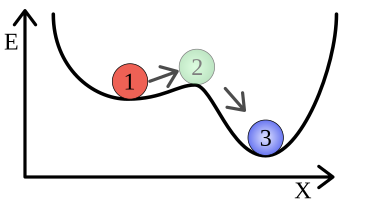
At its heart, metastability describes a system poised in a state that is locally stable but not globally stable. Imagine a ball nestled in a small hollow on a larger slope. This hollow represents a local minimum in the system's potential energy. Small pushes or disturbances will cause the ball to oscillate within the hollow and then return to its resting position, demonstrating stability. However, if a sufficiently large force is applied—exceeding the energy barrier of the hollow's rim—the ball will escape this local minimum and roll down the slope to a lower, more stable position, the global minimum. This transition requires overcoming an activation energy barrier. In chemistry, this is seen in the formation of supersaturated solutions or glasses, where atoms or molecules are arranged in a configuration that is stable for a time but not the lowest possible energy state.
📊 Key Facts & Numbers
Metastable states are characterized by finite lifetimes, meaning they will eventually transition to a more stable state. For example, the lifetime of a metastable atomic state can range from nanoseconds to hours, depending on the specific energy levels and the probability of spontaneous decay. The metastable phase of a steel alloy, such as martensite, can retain its structure for years at room temperature, but it can be transformed into a more stable phase (pearlite or bainite) through tempering at elevated temperatures. The energy barrier separating a metastable state from its ground state can vary dramatically, from a few meV (milli-electronvolts) in some electronic systems to several eV (electronvolts) in solid-state transformations. The probability of transitioning out of a metastable state is often described by Arrhenius-type equations, where the rate is exponentially dependent on the temperature and the height of the energy barrier.
👥 Key People & Organizations
Key figures in understanding metastability include Max Born and Robert Oppenheimer, whose work on molecular vibrations and potential energy surfaces in the early 20th century laid crucial groundwork. Later, Fereydoon Mostofi and George Plischke explored metastable states in nuclear physics. In materials science, researchers like David Turnbull made significant contributions to understanding the kinetics of phase transformations and the formation of metastable amorphous solids. The American Physical Society and the Royal Society have been instrumental in publishing research that advances the understanding of metastability across various fields, fostering collaborations between theoretical physicists and experimental chemists.
🌍 Cultural Impact & Influence
Metastability has permeated scientific thought, influencing how we conceptualize change and stability. The idea that apparent order can be temporary, a fragile equilibrium awaiting a trigger, resonates beyond physics. In fields like ecology, ecosystems can exist in metastable states, resilient to minor environmental shifts but vulnerable to catastrophic collapse if a threshold is crossed. Similarly, in economics, markets can exhibit metastable behaviors, appearing stable until a shock (like a financial crisis) triggers a rapid transition to a new equilibrium. The concept also appears in popular science, often used metaphorically to describe situations of temporary peace or precarious balance, such as in discussions of geopolitical tensions or social unrest, where a seemingly stable situation could rapidly devolve.
⚡ Current State & Latest Developments
Current research continues to refine our understanding of metastability, particularly in complex systems. Advances in computational power allow for more sophisticated simulations of potential energy landscapes, enabling the prediction of metastable phases in novel materials. For instance, researchers are actively investigating metastable high-entropy alloys, which exhibit unusual mechanical properties due to their complex atomic arrangements. In quantum computing, maintaining metastable quantum states (qubits) is paramount for computation, and efforts are focused on extending their coherence times against decoherence, a form of environmental perturbation. The study of metastable states in biological systems, such as protein folding pathways, is also a rapidly growing area, seeking to understand how proteins navigate complex energy landscapes to reach functional configurations.
🤔 Controversies & Debates
A significant debate revolves around the precise definition and classification of metastable states, especially in complex, many-body systems. Some argue for a stricter definition based purely on potential energy minima, while others advocate for a broader view that includes dynamic stability criteria. The predictability of transitions from metastable states is another point of contention; while theoretical models can predict probabilities, accurately forecasting the exact timing and trigger for such transitions in real-world, noisy systems remains a challenge. Furthermore, the ethical implications of intentionally creating or manipulating metastable states, particularly in areas like nuclear energy or advanced materials, are subjects of ongoing discussion.
🔮 Future Outlook & Predictions
The future outlook for metastability research is bright, driven by the need to design advanced materials with tailored properties and to develop more robust quantum technologies. We can expect to see increased exploration of metastable phases in areas like catalysis, where specific surface structures can dramatically enhance reaction rates. The development of new computational tools will likely lead to the discovery of entirely new classes of metastable materials with unprecedented strength, conductivity, or energy storage capabilities. In quantum information science, overcoming decoherence to stabilize metastable qubit states will be a key determinant of progress towards fault-tolerant quantum computers, potentially unlocking computational power currently unimaginable.
💡 Practical Applications
Metastability finds practical application across numerous scientific and engineering domains. In materials science, the creation of metastable phases is a deliberate strategy to achieve desired properties; for example, the metastable phase of diamond (lonsdaleite) is being explored for its potential hardness. In metallurgy, heat treatments are designed to produce metastable microstructures in alloys like steel and aluminum to enhance strength and durability. In chemistry, understanding metastable intermediates is crucial for optimizing reaction pathways and designing efficient catalysts. Even in everyday items, like the 'snap' in self-heating hand warmers (which rely on the rapid crystallization of a metastable supersaturated solution), metastability plays a role.
Key Facts
- Category
- science
- Type
- topic